ORTB
…
SIMID chapter navigation

SIMID 1.0.1

Historical version

Self-declared spec version 1.0.1 · release basis 2020-05-29 · source file simid-1.0.1.html

取官方 Bikeshed 渲染稿 subtitle 的 Living Standard 日期(datetime 属性)

This page reproduces the official original for that version; parameter structures come from the WebIDL blocks in the text.

On this page

Message reference table

The official §4.1 API / resolve / reject table; per-message parameter trees are below — click a message name to jump.

SIMID API is a set of messages and data structures that ad-rendering parties exchange via § 8 Messaging Protocol.

APIresolvereject
SIMID:Media:durationchangen/an/a
SIMID:Media:endedn/an/a
SIMID:Media:errorn/an/a
SIMID:Media:pausen/an/a
SIMID:Media:playn/an/a
SIMID:Media:playingn/an/a
SIMID:Media:seekedn/an/a
SIMID:Media:seekingn/an/a
SIMID:Media:stalledn/an/a
SIMID:Media:timeupdaten/an/a
SIMID:Media:volumechangen/an/a
SIMID:Player:adSkipped§ 4.3.1.1 resolven/a
SIMID:Player:adStopped§ 4.3.2.1 resolven/a
SIMID:Player:appBackgrounded§ 4.3.3.1 resolven/a
SIMID:Player:appForegroundedn/an/a
SIMID:Player:fatalError§ 4.3.5.1 resolven/a
SIMID:Player:init§ 4.3.6.1 resolve§ 4.3.6.2 reject
SIMID:Player:logn/an/a
SIMID:Player:resizen/an/a
SIMID:Player:startCreative§ 4.3.9.1 resolve§ 4.3.9.2 reject
SIMID:Creative:clickThrun/an/a
SIMID:Creative:fatalErrorn/an/a
SIMID:Creative:getMediaState§ 4.4.3.1 resolven/a
SIMID:Creative:logn/an/a
SIMID:Creative:reportTracking§ 4.4.5.1 resolve§ 4.4.5.2 reject
SIMID:Creative:requestChangeAdDuration§ 4.4.6.1 resolve§ 4.4.6.2 reject
SIMID:Creative:requestChangeVolume§ 4.4.7.1 resolve§ 4.4.7.2 reject
SIMID:Creative:requestFullscreen§ 4.4.8.1 resolve§ 4.4.8.2 reject
SIMID:Creative:requestExitFullscreen§ 4.4.9.1 resolve§ 4.4.9.2 reject
SIMID:Creative:requestPause§ 4.4.10.1 resolve§ 4.4.10.2 reject
SIMID:Creative:requestPlay§ 4.4.11.1 resolve§ 4.4.11.2 reject
SIMID:Creative:requestResize§ 4.4.12.1 resolve§ 4.4.12.2 reject
SIMID:Creative:requestSkip§ 4.4.13.1 resolve§ 4.4.13.2 reject
SIMID:Creative:requestStop§ 4.4.14.1 resolve§ 4.4.14.2 reject

SIMID:Media · media events

SIMID specifies a group of messages that describe ad media states. The player prepends such messages with the SIMID:Media namespace.

SIMID borrows media-related semantics and naming conventions from the standard HTMLMediaElement behavior. In player implementations where an HTMLMediaElement is not used, the player must translate events and property values into the associated SIMID:Media message.

In HTML environments, SIMID:Media messages contain the original media event type.

  1. HTMLMediaElement dispatches event play.
  2. Player sets Message.type = SIMID:Media:play.

The player must report SIMID:Media messages immediately after the associated event occurs.

The player must not queue messages in cases where the creative iframe initialization happens in the middle of the ad media playback. The player posts only messages that communicate events that occur after the iframe initialization.

SIMID:Media messages are information-only; they do not trigger resolve/reject responses from the creative.

The player may elect to report all standard HTML media events to the creative. However, the creative should not expect to receive messages with optional types. (See table below.)

Some SIMID:Media messages - durationchange, error, timeupdate, and volumechange - require additional data provided with Message.args parameters.

Required and optional media event types.

Event NameRequiredEvent NameRequiredEvent NameRequired
abortinterruptendseeked
canplayloadeddataseeking
canplaythroughloadedmetadatastalled
durationchangeloadstartsuspend
emptiedpausetimeupdate
encryptedplayvolumechange
endedplayingwaiting
errorprogress
interruptbeginratechange
Event NameRequiredEvent NameRequiredEvent NameRequired
abortinterruptendseeked
canplayloadeddataseeking
canplaythroughloadedmetadatastalled
durationchangeloadstartsuspend
emptiedpausetimeupdate
encryptedplayvolumechange
endedplayingwaiting
errorprogress
interruptbeginratechange

SIMID:Media:durationchange

§4.2.1No response

When the duration of the media changes due to the player receiving the media resource metadata (in HTML, HTMLMediaElement dispatches the durationchange event), the player posts a SIMID:Media:durationchange message.

dictionary MessageArgs {
required float duration;
};
duration,
The duration of the media in seconds. In HTML, HTMLMediaElement.duration value.*
  1. In SSAI, HTMLMediaElement.duration value does not express the actual ad media duration. In such cases, the player must compute the ad’s actual media length.

Parameter structureWebIDL dictionary · MessageArgs

ParameterTypeRequiredValues
durationfloat✓

SIMID:Media:ended

§4.2.2No response

The official spec defines no args for this message.

SIMID:Media:error

§4.2.3No response
dictionary MessageArgs {
required unsigned short error;
required DOMString message;
};
error,
In HTML, the value of HTMLMediaElement.error.code. Codes: 1 The media download was canceled 2 Network error 3 The player failed to decode the media 4 Environment does not support media resource
message,
In HTML, the value of HTMLMediaElement.error.message.

Parameter structureWebIDL dictionary · MessageArgs

ParameterTypeRequiredValues
errorunsigned short✓
messageDOMString✓

SIMID:Media:pause

§4.2.4No response

The official spec defines no args for this message.

SIMID:Media:play

§4.2.5No response

The official spec defines no args for this message.

SIMID:Media:playing

§4.2.6No response
  1. the media has enough data to start playback;
  2. the media recovered from stalled state;
  3. playback restarts;
  4. after seek operation completion.

In HTML, the player posts a Media:playing message when HTMLMediaElement dispatches a playing event.

The official spec defines no args for this message.

SIMID:Media:seeked

§4.2.7No response

The official spec defines no args for this message.

SIMID:Media:seeking

§4.2.8No response

The official spec defines no args for this message.

SIMID:Media:stalled

§4.2.9No response

The official spec defines no args for this message.

SIMID:Media:timeupdate

§4.2.10No response

In HTML, the player sends a Media:timeupdate message HTMLMediaElement dispatches a timeupdate event.

dictionary MessageArgs {
required float currentTime;
};
currentTime,
The value in seconds. In HTML, HTMLMediaElement.currentTime property value.

In Server-Side Ad Insertion, the client-side media playback is a continuous stream which requires additional currentTime calculations. For the current ad, the player must compute the currentTime value as a delta between the actual playhead position and the time the ad started.

Parameter structureWebIDL dictionary · MessageArgs

ParameterTypeRequiredValues
currentTimefloat✓

SIMID:Media:volumechange

§4.2.11No response
dictionary MessageArgs {
required float volume;
required boolean muted;
};
volume,
The number between 0 and 1.*
muted,
true if audio is muted.*
  1. The properties volume and muted describe two independent audio states. While the media is muted, its volume may be greater than zero; while volume is zero, the media may be unmuted.

Parameter structureWebIDL dictionary · MessageArgs

ParameterTypeRequiredValues
volumefloat✓
mutedboolean✓

SIMID:Player · player to creative

SIMID:Player messages do not communicate ad media states; SIMID dedicates § 4.2 Messages Triggered by Media Element Events to report media status.

While some SIMID:Player messages expect resolve and/or reject creative responses, other messages do not require replies.

SIMID:Player messages summary.

Message typeparametersResponses
§ 4.3.1 SIMID:Player:adSkippedn/a§ 4.3.1.1 resolve
§ 4.3.2 SIMID:Player:adStoppedcode§ 4.3.2.1 resolve
§ 4.3.3 SIMID:Player:appBackgroundedn/a§ 4.3.3.1 resolve
§ 4.3.4 SIMID:Player:appForegroundedn/an/a
§ 4.3.5 SIMID:Player:fatalErrorerrorCode errorMessage§ 4.3.5.1 resolve
§ 4.3.6 SIMID:Player:initenvironmentData creativeData§ 4.3.6.1 resolve § 4.3.6.2 reject
§ 4.3.7 SIMID:Player:logmessagen/a
§ 4.3.8 SIMID:Player:resizemediaDimensions creativeDimensions fullscreenn/a
§ 4.3.9 SIMID:Player:startCreativen/a§ 4.3.9.1 resolve § 4.3.9.2 reject
Message typeparametersResponses
§ 4.3.1 SIMID:Player:adSkippedn/a§ 4.3.1.1 resolve
§ 4.3.2 SIMID:Player:adStoppedcode§ 4.3.2.1 resolve
§ 4.3.3 SIMID:Player:appBackgroundedn/a§ 4.3.3.1 resolve
§ 4.3.4 SIMID:Player:appForegroundedn/an/a
§ 4.3.5 SIMID:Player:fatalErrorerrorCode errorMessage§ 4.3.5.1 resolve
§ 4.3.6 SIMID:Player:initenvironmentData creativeData§ 4.3.6.1 resolve § 4.3.6.2 reject
§ 4.3.7 SIMID:Player:logmessagen/a
§ 4.3.8 SIMID:Player:resizemediaDimensions creativeDimensions fullscreenn/a
§ 4.3.9 SIMID:Player:startCreativen/a§ 4.3.9.1 resolve § 4.3.9.2 reject

SIMID:Player:adSkipped

§4.3.1resolve

The player waits for the resolve creative response. The player may time out if the creative takes too long to respond and unload the iframe. The timeout should be reasonable to allow creative to conclude ad-end logic.

The official spec defines no args for this message.

Response · resolve §4.3.1.1

SIMID:Player:adStopped

§4.3.2resolve

The player must stop media playback and hide the creative iframe before reporting Player:adStopped. The player must wait for a resolve response from the creative allotting a reasonable timeout to accommodate creative’s needs to finalize the ad-end logic.

dictionary MessageArgs {
required unsigned short code;
};
code,
Ad stop cause code. Values: 0 Unspecified 1 User-initiated close 2 Auto-close due to media playback completion 3 Player-initiated close before media playback completion 4 Creative-initiated close

Parameter structureWebIDL dictionary · MessageArgs

ParameterTypeRequiredValues
codeunsigned short✓

Response · resolve §4.3.2.1

SIMID:Player:appBackgrounded

§4.3.3resolve

The official spec defines no args for this message.

Response · resolve §4.3.3.1

SIMID:Player:appForegrounded

§4.3.4No response

The official spec defines no args for this message.

SIMID:Player:fatalError

§4.3.5resolve

Regardless of the player’s ability to terminate playback, the player should hide creative iframe and wait for resolve response before unloading iframe.

See § 6.8.5 Ad Errors Out

dictionary MessageArgs {
required unsigned short errorCode;
DOMString errorMessage;
};
errorCode,
See § 9 Error Codes.
errorMessage,
Additional information

Parameter structureWebIDL dictionary · MessageArgs

ParameterTypeRequiredValues
errorCodeunsigned short✓
errorMessageDOMString

Response · resolve §4.3.5.1

See § 6.8.5 Ad Errors Out

SIMID:Player:init

§4.3.6resolvereject

The creative must respond to Player:init with either § 4.3.6.1 resolve or § 4.3.6.2 reject.

dictionary MessageArgs {
required EnvironmentData environmentData;
required CreativeData creativeData;
};
environmentData,
Information about publisher’s environment and media player capacities.
creativeData,
Information that pertains to the specific creative.
dictionary CreativeData {
required DOMString adParameters;
DOMString clickThruUrl;
};
adParameters,
Typically, the value of VAST <AdParameters> node.
clickThruUrl,
Value of VAST <ClickThrough> node.
dictionary EnvironmentData {
required Dimensions videoDimensions;
required Dimensions creativeDimensions;
required boolean fullscreen;
required boolean fullscreenAllowed;
required boolean variableDurationAllowed;
required SkippableState skippableState;
required DOMString version;
DOMString siteUrl;
DOMString appId;
DOMString useragent;
DOMString deviceId;
boolean muted;
float volume;
};

dictionary Dimensions {
required long x;
required long y;
required long width;
required long height;
};

enum SkippableState {"playerHandles", "adHandles", "notSkippable"};
videoDimensions,
Communicates media element coordinates and size.
creativeDimensions,
Communicates creative iframe coordinates and size the player will set when iframe becomes visible.
fullscreen,
The value true indicates that the player is currently in fullscreen mode.
fullscreenAllowed,
Communicates the player’s capacity to toggle screen modes. The value true indicates that creative may request screen mode change. The value false denotes that the player will reject calls to change screen mode.*
variableDurationAllowed,
Communicates player’s capacities† to: interrupt ad playback progress – the ability to pause the media; extend ad user experience length beyond ad media duration after ad playback completion; accommodate creative’s ad stop request. The value true asserts that the player can: pause media playback in response to creative’s requests; extend ad experience after media playback completion (and abstaining from ad unloading) if the creative posts ad duration change instructions; accommodate creative’s ad stop request.‡
skippableState,
Expresses: player’s ability to skip the ad;† VAST skippability-associated instructions logic management; Skip Ad button handling delegation. The value playerHandles indicates that all of the following applies: the publisher controls skippability logic (including handling of VAST skipoffset directives); either VAST contains skipoffset or the skippability is the publisher-administered behavior; the player implements the Skip Ad button; the player will ignore skip requests from the creative. The value adHandles signals that the player: can skip the ad; does not implement internal Skip Ad button; disregards VAST skippability directives; will skip the ad in response to § 4.4.13 SIMID:Creative:requestSkip message.§ The value notSkippable declares that the player: cannot skip the ad; ignores VAST skippability instructions; will disregard skip request from the creative. With both playerHandles and notSkippable, the creative avoids the Skip Ad button drawing.
version,
The SIMID version the player implements.
muted,
true if the player § is muted.◊
volume,
player’s § volume – expressed as a number between 0 and 1.0.
siteUrl,
The URI of the publisher’s site. May be full or partial URL.
appId,
The ID of the mobile app, if applicable.
useragent,
The information about SDKs as well as the player’s vendor and version. The value should comply with VAST-specified conventions.
deviceId,
IDFA or AAID
  1. see § 4.4.8 SIMID:Creative:requestFullscreen and § 4.4.9 SIMID:Creative:requestExitFullscreen messages.
  2. In SSAI, live broadcast, and other time-constrained environments, the player must support uninterrupted media (both content and ads) playback progress. Specifically, the player may not be able to pause the media, shorten ad, or extend user ad experience.
  3. see § 4.4.10 SIMID:Creative:requestPause, § 4.4.11 SIMID:Creative:requestPlay, § 4.4.6 SIMID:Creative:requestChangeAdDuration, and § 4.4.14 SIMID:Creative:requestStop.
  4. SIMID does not expect device audio state information.
  5. Values of muted and volume are independent. While the player is muted, volume can be greater than zero; the volume zero does not mean the player is muted.
Parameter structureWebIDL dictionary · MessageArgs

ParameterTypeRequiredValues
environmentDataEnvironmentData✓
videoDimensionsDimensions✓
xlong✓
ylong✓
widthlong✓
heightlong✓
creativeDimensionsDimensions✓
xlong✓
ylong✓
widthlong✓
heightlong✓
fullscreenboolean✓
fullscreenAllowedboolean✓
variableDurationAllowedboolean✓
skippableStateSkippableState✓playerHandles / adHandles / notSkippable
versionDOMString✓
siteUrlDOMString
appIdDOMString
useragentDOMString
deviceIdDOMString
mutedboolean
volumefloat
creativeDataCreativeData✓
adParametersDOMString✓
clickThruUrlDOMString

Response · resolve §4.3.6.1

The creative acknowledges the initialization parameters.

If the creative delays calling resolve, see § 6.5 Creative Delays Resolving Init.

Response · reject §4.3.6.2

The creative may respond with a reject based on its internal logic.

dictionary MessageArgs {
required unsigned short errorCode;
DOMString reason;
};
errorCode,
See § 9 Error Codes.
reason,
Optional information about rejection cause.

The player then will follow the rejection workflow. See § 6.6 Creative Rejects Init.

ParameterTypeRequiredValues
errorCodeunsigned short✓
reasonDOMString

SIMID:Player:log

§4.3.7No response

Note: In SIMID prefixing log messages with “WARNING:” has a specific meaning. The player is communicating performance inefficiencies or specification deviations aimed at creative developers. For example, if the creative sends the requestChangeVolume message but does not use the correct parameters, a “WARNING:” message is appropriate.

dictionary MessageArgs {
required DOMString message;
};
message,
Logging information.

Parameter structureWebIDL dictionary · MessageArgs

ParameterTypeRequiredValues
messageDOMString✓

SIMID:Player:resize

§4.3.8No response
dictionary MessageArgs {
required Dimensions videoDimensions;
required Dimensions creativeDimensions;
required boolean fullscreen;
};

dictionary Dimensions {
required long x;
required long y;
required long width;
required long height;
};
mediaDimensions,
Media element size and coordinates.
creativeDimensions,
SIMID iframe size and coordinates.*
fullscreen,
Value is true when the ad is in fullscreen mode.
  1. If the iframe is invisible at the time the player posts resize message, the parameter creativeDimensions communicates forthcoming values: iframe’s size, and coordinates once it is displayed.

Parameter structureWebIDL dictionary · MessageArgs

ParameterTypeRequiredValues
videoDimensionsDimensions✓
xlong✓
ylong✓
widthlong✓
heightlong✓
creativeDimensionsDimensions✓
xlong✓
ylong✓
widthlong✓
heightlong✓
fullscreenboolean✓

SIMID:Player:startCreative

§4.3.9resolvereject

See § 6.3 Typical Start Creative WorkFlow

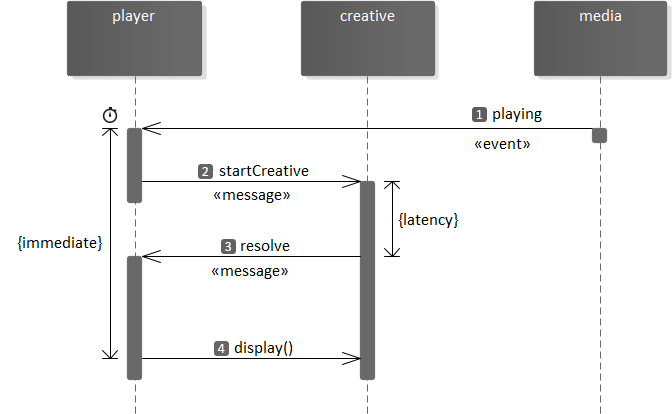
The player posts SIMID:Player:startCreative message when it is ready to make the iframe visible. The player must transmit Player:startCreative as close to the first media frame rendering as possible. The player waits for a § 4.3.9.1 resolve response to display the SIMID iframe. The interactive creative should be ready to reply to Player:startCreative immediately.

§ 4.3.6 SIMID:Player:init section describes the flow that precedes the instant the player emits a Player:startCreative message.

The official spec defines no args for this message.

Response · resolve §4.3.9.1

Refer to § 6.3 Typical Start Creative WorkFlow 2.

If the creative fails to reply with a resolve by the time ad media playback completes, the player reports VAST error tracker with the errorCode 1213. See § 9 Error Codes.

Response · reject §4.3.9.2

dictionary MessageArgs {
required unsigned short errorCode;
DOMString reason;
};
errorCode,
See § 9 Error Codes.
reason,
Additional information.
ParameterTypeRequiredValues
errorCodeunsigned short✓
reasonDOMString

SIMID:Creative · creative to player

SIMID:Creative messages may require the player to accept and process arguments. With some messages, the creative expects the player to respond with resolutions.

Note: In SIMID, the creative initializes the session and posts the first message, createSession. See § 8.4 Session Layer.

SIMID:Creative messages summary.

Message typears parametersResponses
§ 4.4.1 SIMID:Creative:clickThrux yn/a
§ 4.4.2 SIMID:Creative:fatalErrorerrorCode errorMessagen/a
§ 4.4.3 SIMID:Creative:getMediaStaten/a§ 4.4.3.1 resolve
§ 4.4.4 SIMID:Creative:logmessagen/a
§ 4.4.5 SIMID:Creative:reportTrackingtrackingUrls§ 4.4.5.1 resolve § 4.4.5.2 reject
§ 4.4.6 SIMID:Creative:requestChangeAdDurationduration§ 4.4.6.1 resolve § 4.4.6.2 reject
§ 4.4.7 SIMID:Creative:requestChangeVolumevolume muted§ 4.4.7.1 resolve § 4.4.7.2 reject
§ 4.4.9 SIMID:Creative:requestExitFullscreenn/a§ 4.4.9.1 resolve § 4.4.9.2 reject
§ 4.4.8 SIMID:Creative:requestFullscreenn/a§ 4.4.8.1 resolve § 4.4.8.2 reject
§ 4.4.10 SIMID:Creative:requestPausen/a§ 4.4.10.1 resolve § 4.4.10.2 reject
§ 4.4.11 SIMID:Creative:requestPlayn/a§ 4.4.11.1 resolve § 4.4.11.2 reject
§ 4.4.12 SIMID:Creative:requestResizen/a§ 4.4.12.1 resolve § 4.4.12.2 reject
§ 4.4.13 SIMID:Creative:requestSkipn/a§ 4.4.13.1 resolve § 4.4.13.2 reject
§ 4.4.14 SIMID:Creative:requestStopn/a§ 4.4.14.1 resolve § 4.4.14.2 reject
Message typears parametersResponses
§ 4.4.1 SIMID:Creative:clickThrux yn/a
§ 4.4.2 SIMID:Creative:fatalErrorerrorCode errorMessagen/a
§ 4.4.3 SIMID:Creative:getMediaStaten/a§ 4.4.3.1 resolve
§ 4.4.4 SIMID:Creative:logmessagen/a
§ 4.4.5 SIMID:Creative:reportTrackingtrackingUrls§ 4.4.5.1 resolve § 4.4.5.2 reject
§ 4.4.6 SIMID:Creative:requestChangeAdDurationduration§ 4.4.6.1 resolve § 4.4.6.2 reject
§ 4.4.7 SIMID:Creative:requestChangeVolumevolume muted§ 4.4.7.1 resolve § 4.4.7.2 reject
§ 4.4.9 SIMID:Creative:requestExitFullscreenn/a§ 4.4.9.1 resolve § 4.4.9.2 reject
§ 4.4.8 SIMID:Creative:requestFullscreenn/a§ 4.4.8.1 resolve § 4.4.8.2 reject
§ 4.4.10 SIMID:Creative:requestPausen/a§ 4.4.10.1 resolve § 4.4.10.2 reject
§ 4.4.11 SIMID:Creative:requestPlayn/a§ 4.4.11.1 resolve § 4.4.11.2 reject
§ 4.4.12 SIMID:Creative:requestResizen/a§ 4.4.12.1 resolve § 4.4.12.2 reject
§ 4.4.13 SIMID:Creative:requestSkipn/a§ 4.4.13.1 resolve § 4.4.13.2 reject
§ 4.4.14 SIMID:Creative:requestStopn/a§ 4.4.14.1 resolve § 4.4.14.2 reject

SIMID:Creative:clickThru

§4.4.1No response

The SIMID:Creative:clickThru message notifies the player of a clickthrough for event tracking. SIMID delegates clickthrough execution to the creative, including redirecting the user to the landing page. The interactive component posts clickThru only when the creative classifies a user interaction as a clickthrough.

The message, clickThru, is not an explicit media-pausing directive to the player. If the environment permits, the player must pause ad media in all cases when the user navigates away from the player hosting page or app, including clickthrough. See Page Visibility API.

dictionary MessageArgs {
short x;
short y;
};
x,
The click left offset in the creative’s coordinate system.
y,
The click top offset in the creative’s coordinate system.

Parameter structureWebIDL dictionary · MessageArgs

ParameterTypeRequiredValues
xshort
yshort

SIMID:Creative:fatalError

§4.4.2No response
dictionary MessageArgs {
required unsigned short errorCode;
DOMString errorMessage;
};
errorCode,
See § 9 Error Codes.
errorMessage,
Additional information.

Parameter structureWebIDL dictionary · MessageArgs

ParameterTypeRequiredValues
errorCodeunsigned short✓
errorMessageDOMString

SIMID:Creative:getMediaState

§4.4.3resolve

The official spec defines no args for this message.

Response · resolve §4.4.3.1

dictionary MessageArgs {
DOMString currentSrc;
float currentTime;
float duration;
boolean ended;
boolean muted;
boolean paused;
float volume;
boolean fullscreen;
};
currentSrc,
The URI to the media publisher chooses for the playback. This value is optional and may not be provided in the case of server side ad insertion.
currentTime,
The time elapsed since the first ad media frame.
duration,
Ad media duration.
ended,
In HTML, the value of HTMLMediaElement.ended attribute.
muted,
In HTML, the value of HTMLMediaElement.muted attribute.
paused,
In HTML, the value of HTMLMediaElement.paused attribute.
volume,
In HTML, the value of HTMLMediaElement.volume attribute.
fullscreen,
he value is true if the media element is in full screen..
ParameterTypeRequiredValues
currentSrcDOMString
currentTimefloat
durationfloat
endedboolean
mutedboolean
pausedboolean
volumefloat
fullscreenboolean

SIMID:Creative:log

§4.4.4No response

Note: If the log message purpose is to notify the player about the player’s non-standard behavior, the creative prepends Message.args.message value with “WARNING:” string. Warning messages are used to inform player developers about occurances of non-fatal issues.

dictionary MessageArgs {
required DOMString message;
};
message,
Logging information.

Parameter structureWebIDL dictionary · MessageArgs

ParameterTypeRequiredValues
messageDOMString✓

SIMID:Creative:reportTracking

§4.4.5resolvereject

The SIMID:Creative:reportTracking message enables a creative to delegate arbitrary metrics reporting to the player.

The creative may inject macros into trackers URIs.

In response to the reportTracking message, the player must:

  1. Send the trackers specified by the message as soon as possible.
  2. Replace VAST-supported macros with the corresponding values.
  3. Accept and send the trackers with custom macros – leave non-standard macros intact unless the publisher-ad integration involves custom macros processing.
dictionary MessageArgs {
required Array trackingUrls;
};
trackingUrls,
Array of URIs.

Parameter structureWebIDL dictionary · MessageArgs

ParameterTypeRequiredValues
trackingUrlsArray✓

Response · resolve §4.4.5.1

Response · reject §4.4.5.2

dictionary MessageArgs {
required unsigned short errorCode;
DOMString reason;
};
errorCode,
See § 9 Error Codes.
reason,
Additional information.
ParameterTypeRequiredValues
errorCodeunsigned short✓
reasonDOMString

SIMID:Creative:requestChangeAdDuration

§4.4.6resolvereject

In response to user interaction, the creative is requesting a new ad duration.

In SIMID, ad’s media determines the initial ad duration. The ad span may change due to user interaction. When ad duration changes, the creative posts Creative:requestChangeAdDuration message that communicates an updated value. In response to the requestChangeAdDuration message, the player adjusts ad-end timing and updates its ad progress UI (eg., countdown).

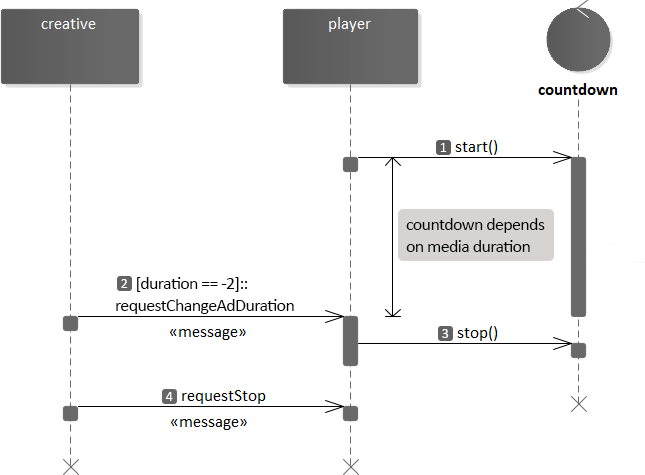
The creative expresses a known duration value in seconds. In cases where the duration is unknown (typically due to user interaction), the value is -2. With a known duration, the player unloads the ad automatically once the countdown (ad remaining time) reaches zero. See § 6.9.1 Ad Extends Beyond Media Completion 456).

When the duration value is -2, the player displays the ad indefinitely until the creative posts § 4.4.14 SIMID:Creative:requestStop. See § 6.9.3 Ad Duration Changed Workflow - Unknown Time step 4).

Note: The player communicates its capacities to modify the ad duration with § 4.3.6 SIMID:Player:init message args parameter variableDurationAllowed. If the value of variableDurationAllowed is false, the creative refrains from posting requestChangeAdDuration message.

dictionary MessageArgs {
required float duration;
};
duration,
Value in seconds for a known duration. The value -2 indicates an unknown duration.

See § 6.9 Ad Duration Changed Workflow.

Parameter structureWebIDL dictionary · MessageArgs

ParameterTypeRequiredValues
durationfloat✓

Response · resolve §4.4.6.1

Note: The player must accommodate an ad duration change directive if the value of the § 4.3.6 SIMID:Player:init message parameter variableDurationAllowed is true.

Response · reject §4.4.6.2

  1. It ignored the duration change request;
  2. Ad media playback continues uninterrupted;
  3. The player will stop and unload the ad once any of the prescribed player-side ad-end triggers arise.

Note: The single SIMID-supported reason for a reject in response to requestChangeAdDuration is the player’s inability to alter media progress.

SIMID:Creative:requestChangeVolume

§4.4.7resolvereject
dictionary MessageArgs {
required float volume;
required boolean muted;
};
volume,
The number between 0 and 1.*
muted,
true if media audio should be muted.*
  1. Properties volume and muted describe two independent audio states. While media is muted, its volume may be greater than zero; at the same time with zero volume, media may be unmuted.

Parameter structureWebIDL dictionary · MessageArgs

ParameterTypeRequiredValues
volumefloat✓
mutedboolean✓

Response · resolve §4.4.7.1

Response · reject §4.4.7.2

SIMID:Creative:requestFullscreen

§4.4.8resolvereject

Note: the player communicates its capacity to toggle screen modes with § 4.3.6 SIMID:Player:init message parameter fullscreenAllowed. When the value of fullscreenAllowed is false, the creative refrains from posting Creative:requestFullscreen message.

The official spec defines no args for this message.

Response · resolve §4.4.8.1

Response · reject §4.4.8.2

  1. Incapable of toggling between screen modes.
  2. Already in the fullscreen mode.
  3. Disallows fullscreen mode.

SIMID:Creative:requestExitFullscreen

§4.4.9resolvereject

Note: the player communicates its capacity to toggle screen modes with § 4.3.6 SIMID:Player:init message parameter fullscreenAllowed. When the value of fullscreenAllowed is false, the creative refrains from posting Creative:requestExitFullscreen message.

The official spec defines no args for this message.

Response · resolve §4.4.9.1

Response · reject §4.4.9.2

  1. Incapable of toggling between screen modes or
  2. Already in the normal-screen mode.

SIMID:Creative:requestPause

§4.4.10resolvereject

Note: the player communicates its capacity to interrupt media playback with § 4.3.6 SIMID:Player:init message, parameter variableDurationAllowed. The creative must not post requestPause if the player sets variableDurationAllowed value to false.

The official spec defines no args for this message.

Response · resolve §4.4.10.1

Response · reject §4.4.10.2

SIMID:Creative:requestPlay

§4.4.11resolvereject

Note: the player communicates its capacity to interrupt media playback with § 4.3.6 SIMID:Player:init message, parameter variableDurationAllowed. The creative must not post requestPlay if the player sets variableDurationAllowed value to false.

The official spec defines no args for this message.

Response · resolve §4.4.11.1

Response · reject §4.4.11.2

SIMID:Creative:requestResize

§4.4.12resolvereject

The creative requests ad resize by posting a SIMID:Creative:requestResize message.

The player must not resize the ad unless it can change the dimensions of both media element and SIMID iframe to the values specified by the Creative:requestResize message.

Note: the message requestResize must not be used to change screen mode. See the § 4.4.8 SIMID:Creative:requestFullscreen and § 4.4.9 SIMID:Creative:requestExitFullscreen messages.

dictionary MessageArgs {
required Dimensions mediaDimensions;
required Dimensions creativeDimensions;
};
dictionary Dimensions {
required long x;
required long y;
required long width;
required long height;
};
mediaDimensions,
Media element size and coordinates.
creativeDimensions,
SIMID iframe size and coordinates.

Parameter structureWebIDL dictionary · MessageArgs

ParameterTypeRequiredValues
mediaDimensionsDimensions✓
xlong✓
ylong✓
widthlong✓
heightlong✓
creativeDimensionsDimensions✓
xlong✓
ylong✓
widthlong✓
heightlong✓

Response · resolve §4.4.12.1

Response · reject §4.4.12.2

SIMID:Creative:requestSkip

§4.4.13resolvereject

The creative requests the player skip ad playback if possible.

See § 6.8.2 Creative Skips Ad

The official spec defines no args for this message.

Response · resolve §4.4.13.1

Response · reject §4.4.13.2

  1. The media playback continues.
  2. The iframe remains visible.
  3. The player continues posting SIMID:Media and SIMID:Player messages to the SIMID iframe.
  4. The creative maintains two-way communication with the player; it waits for, and responds to, the player transmitting ad completion related messages.

SIMID:Creative:requestStop

§4.4.14resolvereject

The creative requests the player stop video playback if possible.

See § 6.8.6 Ad Requests Stop

The official spec defines no args for this message.

Response · resolve §4.4.14.1

Response · reject §4.4.14.2

  1. The media playback continues - if not previously ended;
  2. The iframe remains visible;
  3. The player continues posting messages to the iframe.

The creative keeps communication with the player open; it waits for, and responds to, the player transmitting ad completion related messages.

Messaging protocol (data / transport / session)

In SIMID, the media player and the creative overlay communicate by exchanging asynchronous signals that maintain a custom messaging protocol. This protocol governs § 8.1 Data Layer, § 8.3 Transport Layer, and § 8.4 Session Layer.

Message structure

MemberTypeRequired
sessionIdDOMString✓
messageIdunsigned long✓
timestampunsigned long✓
typeDOMString✓
argsany

Data layer

8.1Data Layer

8.1.1Data Structure

The message data implements the following data structure:

dictionary Message {
required DOMString sessionId;
required unsigned long messageId;
required unsigned long timestamp;
required DOMString type;
any args;
};
sessionId,
A string that uniquely identifies the session to which Message belongs. See § 8.4 Session Layer.
messageId,
A message sequence number in the sender’s system. Each participant establishes its own independent sequence counter for the session. The first message messageId value is 0. The sender increments each subsequent messageId value by 1. In practice, this means that the creative and the player messageId values will be different based on the number of sent messages.
timestamp,
A number of milliseconds since January 1, 1970, 00:00:00 UTC (Epoch time). The message sender must set timestamp value as close as possible to the moment the underlying process occurs. However, the receiver should not assume that the timestamp value reflects the exact instant the message-triggering event occurred.
type,
A string that describes the message-underlying event and informs the receiver how to interpret the args parameter.
args,
Additional information associated with the message type.
{
sessionId: "173378a4-b2e1-11e9-a2a3-2a2ae2dbcce4",
messageId: 10,
timestamp: 1564501643047,
type: "SIMID:Player:adStopped",
args: {
code: 0
}
}

Message categories

8.2Messages Categories

The protocol defines two message classes:

  1. Primary messages - the signals triggered by the sender’s internal logic.
  2. Response messages - the signals the receiver transmits as acknowledgments of the primary message receipt and processing. There are two response Message types: § 8.2.1 resolve Messages and § 8.2.2 reject Messages.

Both primary and response messages implement the same data structure (see § 8.1.1 Data Structure).

8.2.1resolve Messages

The receiver confirms successful message processing by replying with a resolution message.

Message.type must be resolve.

Message.args must be a ResolveMessageArgs object:

dictionary ResolveMessageArgs {
required unsigned long messageId;
any value;
};
messageId,
The value of the messageId attribute of the message to which the receiver responds.
value,
Additional data associated with this resolve message.
{
sessionId: "173378a4-b2e1-11e9-a2a3-2a2ae2dbcce4",
messageId: 10,
timestamp: 1564501643047,
type: "resolve",
args: {
messageId: 5,
value: {
id: 45
}
}
}

8.2.2reject Messages

When the receiver is unable to process the message, it responds with rejection.

Message.type must be reject.

Message.args.value must be a RejectMessageArgsValue object:

dictionary RejectMessageArgsValue {
unsigned long errorCode;
DOMString message;
};
errorCode,
The error code associated with the reason the receiver rejects the message.
message,
Additional information.
{
sessionId: "173378a4-b2e1-11e9-a2a3-2a2ae2dbcce4",
messageId: 10,
timestamp: 1564501643047,
type: "resolve",
args: {
messageId: 5,
value: {
errorCode: 902,
message: "The feature is not available."
}
}
}

Transport layer

8.3Transport Layer

Transport is a communication mechanism that can send serialized messages between two parties.

8.3.1postMessage Transport

In HTML environments, where the player loads creative overlay in a cross-origin iframe, the parties utilize the standard Window.postMessage() API as the message transport mechanism.

8.3.2Message Serialization

The message sender serializes data into a JSON string. The deserialized JSON must result in a clone of the original Message data object.

In JavaScript, JSON.stringify() performs serialization; JSON.parse() - deserialization.

Session layer

8.4Session Layer

The media player may manage several ads that are in different phases of their lifespans; multiple concurrent sessions may be active. For example, while the player is rendering ad-A, it preloads and engages ad-B. Simultaneous two-way communication between the player and both ads persists.

Each session has a unique identifier. All messages that belong to a specific session must reference the same session id.

8.4.1Establishing a New Session

SIMID delegates the session initialization to the creative overlay. The creative generates a unique session id and posts the first session message with the Message.type createSession. By posting the createSession message, the creative acknowledges its readiness to receive messages from the player.

Note: There is no expectation for the interactive component to be entirely able to participate in ad rendering at the time the creative signals createSession message. Full creative initialization may occur at later stages when the player provides complete data - see § 4.3.6 SIMID:Player:init.

{
sessionId: "173378a4-b2e1-11e9-a2a3-2a2ae2dbcce4",
messageId: 0,
timestamp: 1564501643047,
type: "createSession",
args: { }
}

Creative should initialize the session as soon as possible. The player should establish a reasonable timeout for the session initialization message receipt.

The player responds to createSession with a resolve message.

Typical session initialization.
Typical Session Initialization Sequence

8.4.2Session Establishing Delays and Failures

Typically, the player should wait for the creative to post a createSession message before proceeding to the simultaneous rendering of both ad media and the interactive component. However, SIMID recognizes scenarios when:

  1. The creative fails to establish a session within the allotted time.
  2. The player’s environment restricts timeout usage (effectively, the timeout is zero). Specifically, SSAI and live broadcasts force zero-timeout use cases.

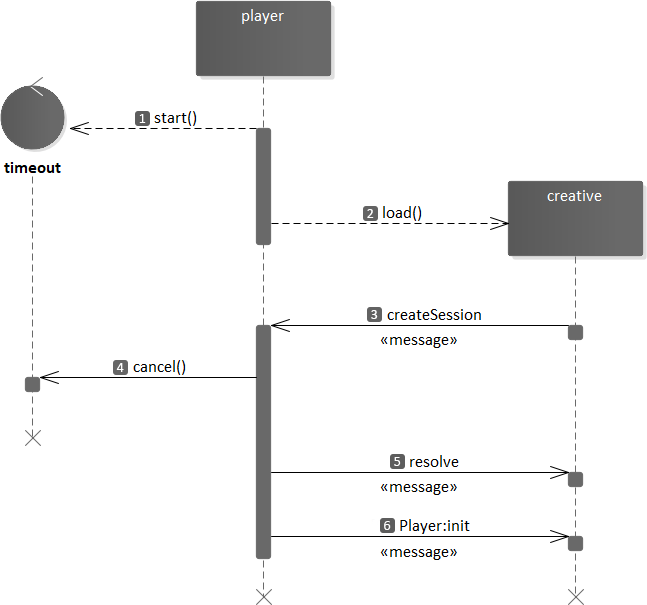
The creative’s failure to establish a session does not prevent the player from rendering the ad media. If the creative does not post a createSession message on time, the player may proceed with the ad media rendering. However, the player allows the creative to recover in the middle of the ad media playback. The player:

  1. Does not unload the creative.
  2. Does not post messages to the creative.
  3. Maintains the creativeSession message handler.

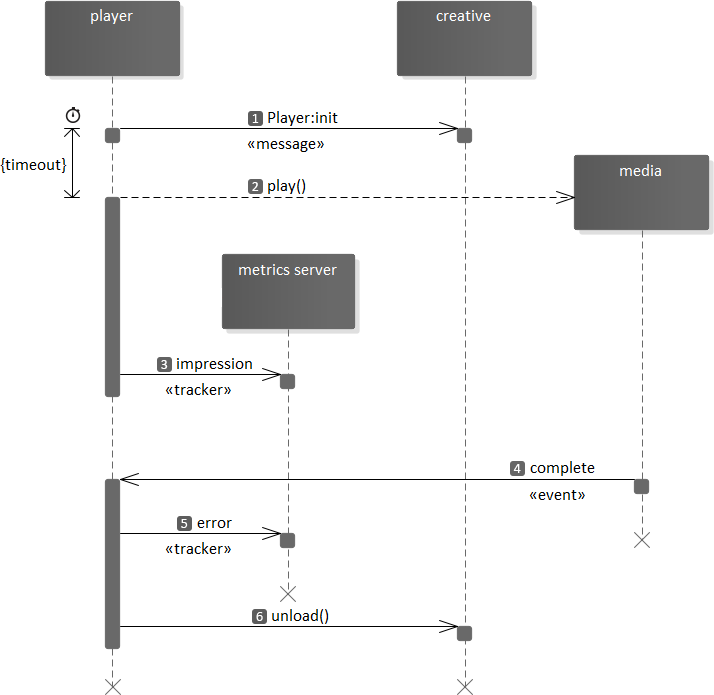
If the creative has not established a session before the media playback is complete, the player will report a VAST Error tracker with the proper error code. Examples of situations when this may occur are listed below.

Sequence for a failed session initialization

  1. The timeout expires.
  2. The createSession message does not arrive.
  3. The player starts ad media.
  4. The player reports the impression.
  5. The ad media playback completes.
  6. The player reports the VAST error tracker.
  7. The player unloads the creative iframe.

Creative posts a createSession message after the timeout occurs

  1. The timeout expires.
  2. The player retains the interactive component.
  3. The player initiates ad media playback.
  4. The player reports the impression.
  5. The player does not post messages to the creative.
  6. The creative posts createSession message.
  7. The player proceeds with the creative initialization.

Enumerations

EnumValues
SkippableStateplayerHandles / adHandles / notSkippable

Error codes

If the media cannot be played the player should terminate the ad and fire an error using the standard VAST errors.

If either the interactive ad or player wants to terminate with an error the player should fire a 902 error. In cases where this is not possible like live server side ad insertion the player should remove the ad overlay and continue tracking quartiles and completion.

The ad or player should pass a specific error code to indicate why it errored out. The ad can also hand back a string with extra details about the error.

Creative side (1100-1199): 12Player side (1200-1299): 14
CodeTypeDescription
1100Unspecified error.Catchall error if the creative could not find a matching error code. The creative should be more specific in the error message.
1101Resources could not be loaded.The SIMID creative tried to load resources but failed.
1102Playback area not usable by creative.The dimensions the creative needed were not what it received.
1103Wrong SIMID version.The creative could not support the players version.
1104Creative not playable for a technical reason on this site.
1105Request for expand not honored.The creative requested to expand but the player did not allow it.
1106Request for pause not honored.The creative requested pause but the player did not pause.
1107Play mode not adequate for creative.The creative requires playback control but the player is not giving control. This error should only fire if the VAST for the ad specified that it needs playback control.
1108Ad internal error.The creative had an error not related to any external dependencies.
1109Device not supported.The creative could not play or render on the device.
1110The player is not following the spec in the way it sends messages.
1111The player is not responding adequately to messages.
1200Unspecified error.Catchall error if the player could not find a matching error code. The player should be more specific in the error message.
1201Wrong SIMID version.The player could not support the creatives version.
1202SIMID creative requesting more time than the player is willing to support.
1203SIMID creative requesting more functionality than the player is willing to support.
1204SIMID creative is doing actions not supported on this site.
1205SIMID creative is overloading the postmessage channel.
1206The SIMID media could not be loaded.
1207Media Timeout.The ad media creative buffered for too long and timed out.
1208The SIMID creative is taking too long to resolve or reject messages.
1209The SIMID creatives media from the VAST response is not supported on this device.
1210The SIMID creative is not following the spec when initializing.
1211The SIMID creative is not following the spec in the way it sends messages.
1212The SIMID creative did not reply to the initialization message.
1213The SIMID creative did not reply to the start message.

Terminology

SIMID VAST
The VAST document that contains the SIMID ad unit components.
SIMID Ad Unit
The SIMID ad media and the SIMID ad creative.
SIMID Media
The SIMID ad media component if it’s a progressively downloaded media file.
SIMID Media Stream
The SIMID ad media component if it’s SSAI media.
SIMID Live Media Stream
The SIMID ad media component if live streaming media.
SIMID Creative
The SIMID ad creative component (HTML document and assets) that overlays the SIMID ad video.
SIMID Secondary Video
Video assets that are loaded as part of the SIMID creative and not the primary media.
Content Media
Any reference to media that is NOT a component or asset of the ad unit.

VAST carriage

The VAST 4.x response designates the <InteractiveCreativeFile> element to describe the ad’s interactive component data. For SIMID, <InteractiveCreativeFile> element must include the following required attributes and their values: type="text/html" and apiFramework="SIMID".

<InteractiveCreativeFile type="text/html" apiFramework="SIMID" variableDuration="true">
<![CDATA[https://adserver.com/ads/creative.html]]>
</InteractiveCreativeFile>

The value of the apiFramework attribute identifies SIMID as the required API for the creative. Players that do not support the SIMID API may load an audio or video file included with the ad, but they will not load or play the SIMID creative.

Media players that do support the SIMID API should handle version negotiation between the creative and the media player via the § 6.1 How to Handle Ad Loading algorithm. The SIMID API version is not identified by any element or attribute in the VAST file.

A third, optional attribute which may be included on the InteractiveCreativeFile element is variableDuration="true". If present, this attribute indicates that the ad unit is only playable if the media player allows the creative to pause playback of the ad’s audio or video and extend the duration of the ad break (for example, with interactive content such as a game or survey). If the player does not support or allow this capability, then it must not render the current ad’s audio/video or SIMID creative. The player should error out the ad instead (and either resume its primary content or continue on to the next ad in the current ad pod).

VAST · AdCOM apiFramework

Common workflows

6.1How to Handle Ad Loading

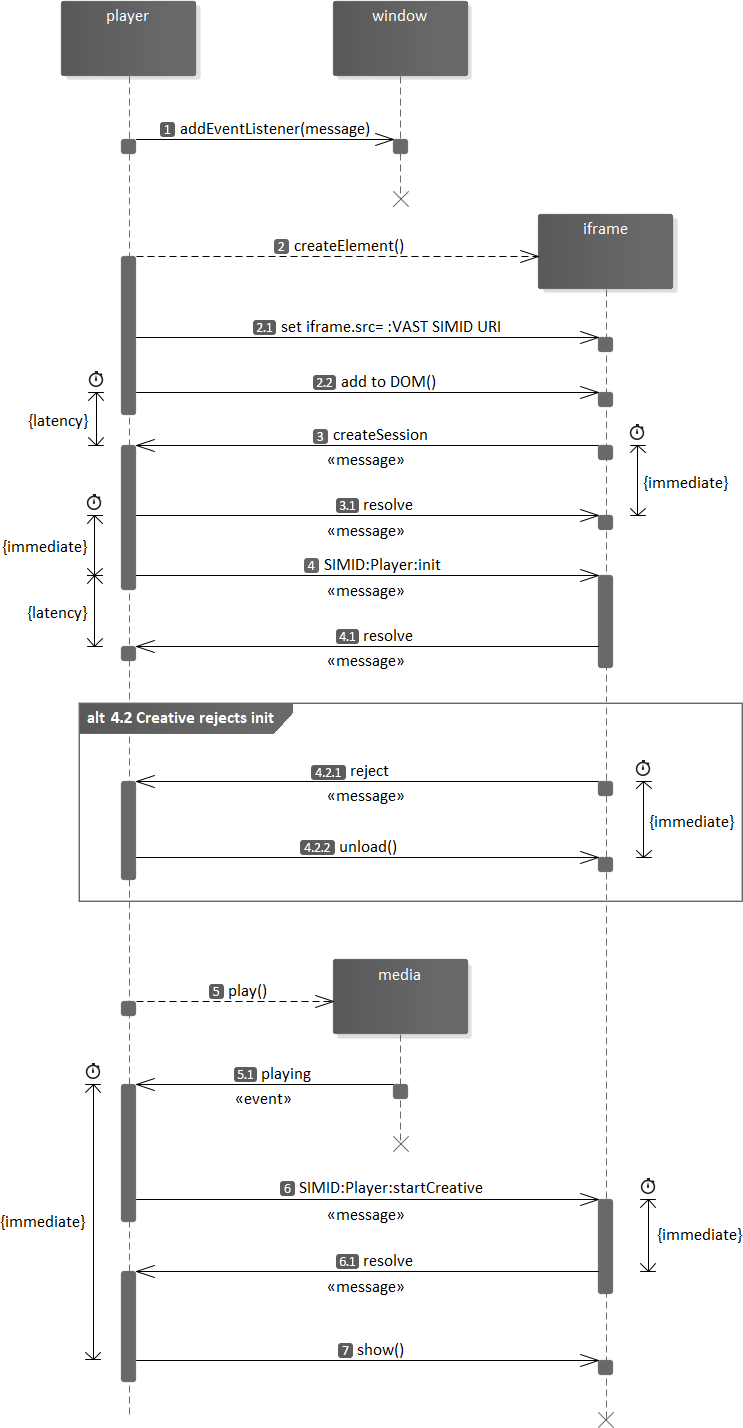
The player must follow this workflow for loading an ad. See Diagram - SIMID Loading and Initialization below.

  1. The player creates an iframe for the SIMID interactive component. The iframe should start hidden. While invisible, the iframe must be capable of executing JavaScript and loading resources.
  2. The player starts listening to the message event on the window that is the parent of the creative iframe.
  3. The player sets the iframe src attribute to the URL provided by the creative’s VAST <InteractiveCreativeFile/> element. The player must assume the iframe is cross-origin.
  4. The player waits until the creative initializes a session and posts createSession message (see § 8.4 Session Layer). The player responds to the session initialization with a resolve message.
  5. The player sends a § 4.3.6 SIMID:Player:init message with relevant parameters. The player waits until the creative responds with § 4.3.6.1 resolve. If the creative responds with § 4.3.6.2 reject, the player should unload the creative’s iframe.
  6. Where possible, to synchronize media playback and the creative UI, the player should wait until both the creative has responded to the § 4.3.6 SIMID:Player:init with § 4.3.6.1 resolve and the media is ready to play. Media readiness means sufficient payload arrived, and the first frame shows.
  7. When the media starts, the player sends a § 4.3.9 SIMID:Player:startCreative message. The creative should respond to § 4.3.9 SIMID:Player:startCreative message with § 4.3.9.1 resolve immediately.
  8. The player makes the iframe visible. With video ads, the player must position the iframe over media element at player’s upper-left corner and set iframe dimensions to media’s width and height.
SIMID Initialization.
SIMID Loading and Initialization
6.2Typical Initialization WorkFlow

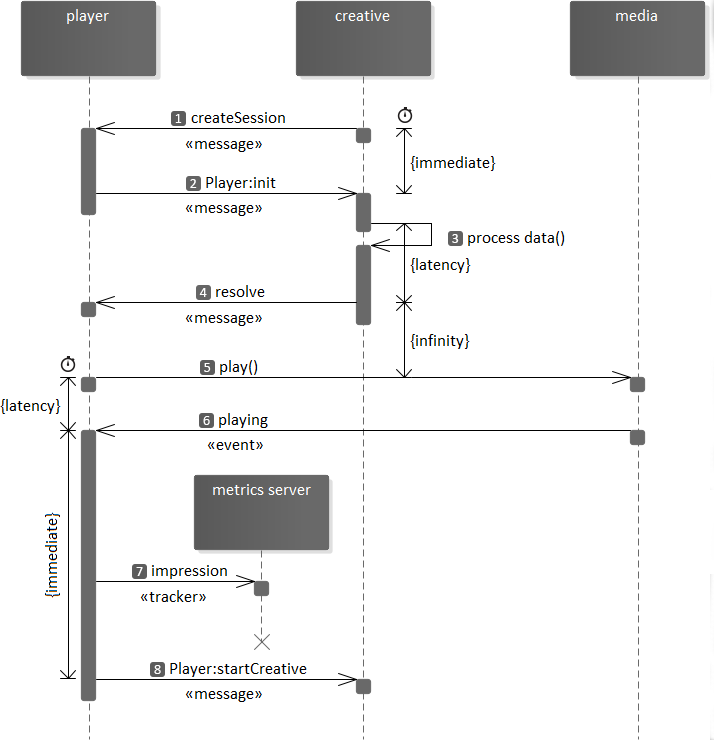
The ideal user ad experience has the simultaneous start of media playback and display of the interactive overlay (the SIMID creative). Once the SIMID creative recieves the Player:init message, its may not yet be ready to display (for example it maybe be loading assets). To accommodate this latency, the player posts a Player:init message before ad media playback begins and waits for the SIMID iframe to respond with § 4.3.6.1 resolve.

The player should post Player:init as soon as the creative dispatches a createSession message (section § 8.4.1 Establishing a New Session) Normal Ad Initilaizatioin Sequence, 12. SIMID creative code must be ready to process the Player:init message immediately 3).

After the player gets a resolve message Normal Ad Initilaizatioin Sequence, 4, it initializes media playback at its discretion 5. Once media rendering begins 6, the player reports impression 7 and posts § 4.3.9 SIMID:Player:startCreative 8.

Normal Ad Initilaizatioin Sequence
Normal Ad Initilaization Sequence
6.3Typical Start Creative WorkFlow
startCreative normal sequence.
Normal Player:startCreative Sequence
6.4Uninterrupted Initialization WorkFlow

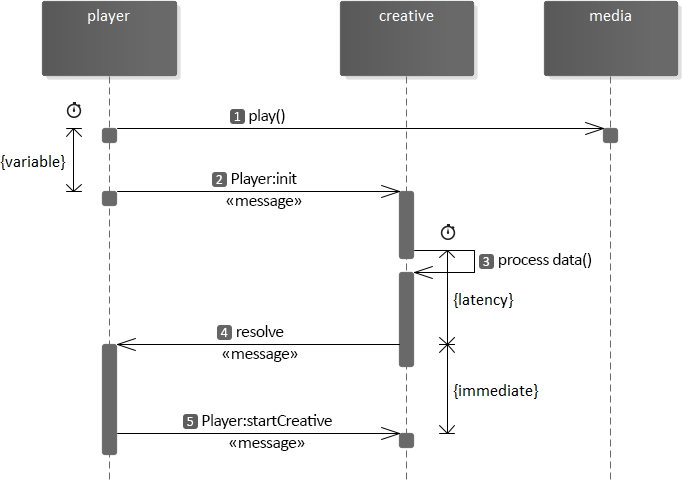
In the case where publisher environments prohibit media playback interruptions, waiting for the creatives is not possible. The media player renders the ad media immediately - before the creative confirms its readiness (Special Creative Initialization Cases, 1). Some examples include SSAI and live broadcasts.

In these situations, the player keeps the iframe invisible and refrains from posting messages to the creative until it responds to the Player:init with a resolve message.

Creative initialization special cases sequence
Special Creative Initialization Cases
6.5Creative Delays Resolving Init

The interactive creative responding to a Player:init message with a resolve message is a critical step in the SIMID ad serving flow (Init Diagram, 4 above). The player keeps the SIMID iframe invisible and does not post either SIMID:Player or SIMID:Media messages until the iframe replies with a resolve message.

If the interactive creative fails to respond to a Player:init message within the allotted time, the player may continue with ad media rendering only (Player:init resolve 2).

The player maintains the hidden interactive creative until ad media playback completion.

If the interactive creative does not resume communication by the playback end, the player must report the VAST error tracker (if available) with the code 1212. See Player:init resolve 5).

Player:init resolve delay
6.6Creative Rejects Init

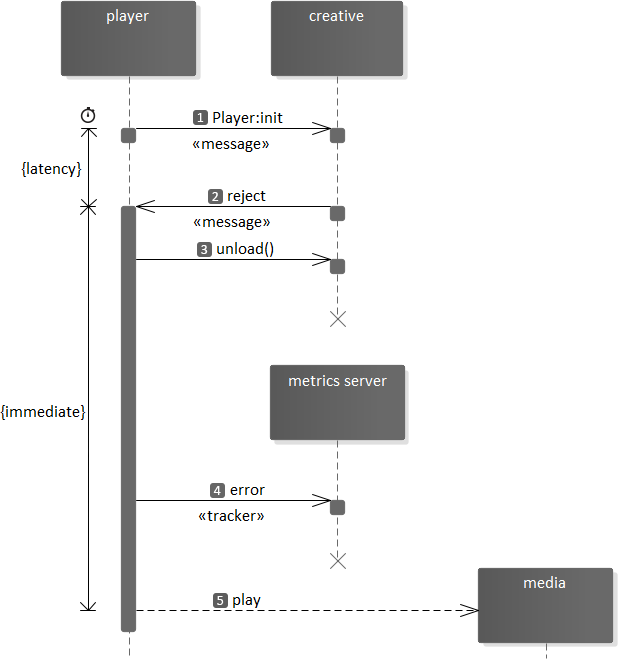
The creative may respond with a reject based on its internal logic. In response to reject, the player proceeds with the ad media playback. The player may unload the iframe. The player reports VAST error trackers with the errorCode specified by the creative.

Player:init reject sequence.
Player:init reject Sequence
6.7How to Handle Ad Playback

The media player is responsible for ad media playback handling as well as tracking media related events. The SIMID creative manages interactive content and internal tracking related to interactivity.

6.7.1Ad Pause

If the variableDurationAllowed flag is set to true then the player should enable media pause by the SIMID creative via the SIMID:Creative:requestPause message. The player must respond to SIMID:Creative:requestPause with the AdPaused event.

When the SIMID creative would like to resume media playback, it should send a SIMID:Creative:requestPlay message. The player must respond to SIMID:Creative:requestPlay message with resolve and play the media.

6.7.2Ad Resizing and Fullscreen

The player may resize the ad slot. The player must send a § 4.3.8 SIMID:Player:resize message any time the ad slot size is changed.

If fullscreenAllowed is true, the SIMID creative may send a § 4.4.8 SIMID:Creative:requestFullscreen message. The player must resize only the ad slot to fullscreen (not the video). The SIMID creative then will resize the video as it sees fit. The player must send a § 4.3.8 SIMID:Player:resize message to the SIMID creative with fullscreen set to true and videoDimensions and creativeDimensions set to the fullscreen dimensions.

If player goes fullscreen on its own. Then the player must send a § 4.3.8 SIMID:Player:resize message to the SIMID creative with fullscreen set to true and videoDimensions and creativeDimensions set to the fullscreen dimensions.

6.8How to Handle Ad End and Unload

Following are cases where ad can end:

  1. Ad was skipped, either by player (see § 6.8.1 Player Skips Ad) or creative (See § 6.8.2 Creative Skips Ad).
  2. The creative has fired § 4.4.14 SIMID:Creative:requestStop message and the player has allowed the ad to stop.
  3. The player has fired § 4.3.2 SIMID:Player:adStopped message and the creative resolved.
  4. Ad errors out. See § 6.8.5 Ad Errors Out.
6.8.1Player Skips Ad

Skip Ad Handled by Player

  1. The player sends a § 4.3.1 SIMID:Player:adSkipped message to the ad.
  2. The player hides the creative.
  3. The creative may dispatch any tracking pixels via § 4.4.5 SIMID:Creative:reportTracking
  4. The creative may wait for § 4.4.5.1 resolve from the reportTracking message.
  5. The creative dispatches resolve on the adSkipped message § 4.3.1.1 resolve.
  6. The player fires any skip tracking pixels.
  7. The player unloads the ad.
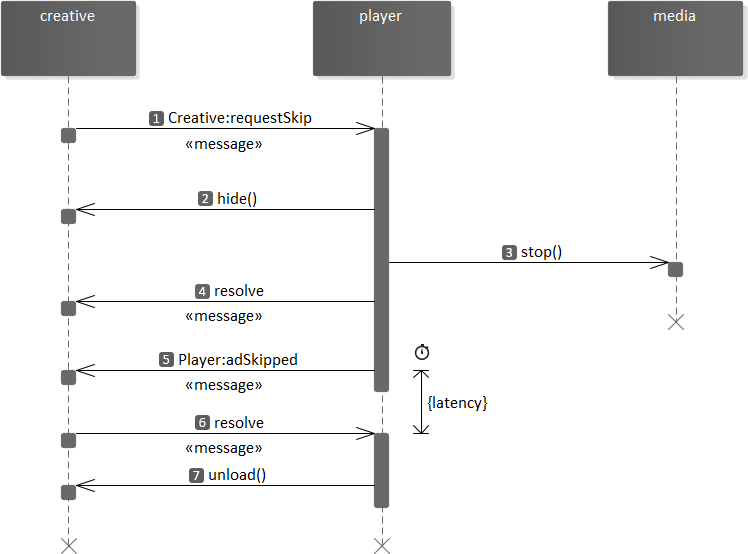
6.8.2Creative Skips Ad

Note: the SIMID interactive component implements skip related behavior and features ( Skip Ad button) only if the player delegates skippability to the creative - the value of § 4.3.6 SIMID:Player:init message args.environmentData.skippableState is "adHandles".

Creative:requestSkip sequence.
Creative:requestSkip Sequence
6.8.3Ad Ends Before Media Completion

This scenario applies when the creative signal to the player to dismiss the ad, typically at the prompting of the user. A good example is a survey that allows the viewer to skip immediately to content when completed.

  1. The ad cleans up and dispatches § 4.4.14 SIMID:Creative:requestStop.
  2. The player unloads the ad.
6.8.4Ad Completes at Media Completion

When an ad finishes at the same time as its media.

  1. The player sends a § 4.3.2 SIMID:Player:adStopped message to the ad.
  2. The player hides the creative.
  3. The creative may dispatch any tracking pixels via § 4.4.5 SIMID:Creative:reportTracking
  4. The creative may wait for a § 4.4.5.1 resolve response message from the reportTracking message.
  5. The creative dispatches resolve on the adStopped message § 4.3.2.1 resolve.
  6. The player unloads the ad.
6.8.5Ad Errors Out

The SIMID creative or the player may terminate the ad unit with an error at any time. If the SIMID creative indicates an error, the player should try to stop ad unit playback. This might not be possible in server side stitched ads.

The player may error out if the ad does not respond with § 4.3.6.1 resolve in a reasonable amount of time.

When an player errors out it must follow these steps.

  1. The player sends a § 4.3.5 SIMID:Player:fatalError message to the ad.
  2. The player hides the creative.
  3. The creative may dispatch any tracking pixels via § 4.4.5 SIMID:Creative:reportTracking
  4. The creative may wait for a § 4.4.5.1 resolve response from the reportTracking message.
  5. The creative dispatches resolve on the fatalError message § 4.3.5.1 resolve.
  6. The player unloads the ad.
6.8.6Ad Requests Stop

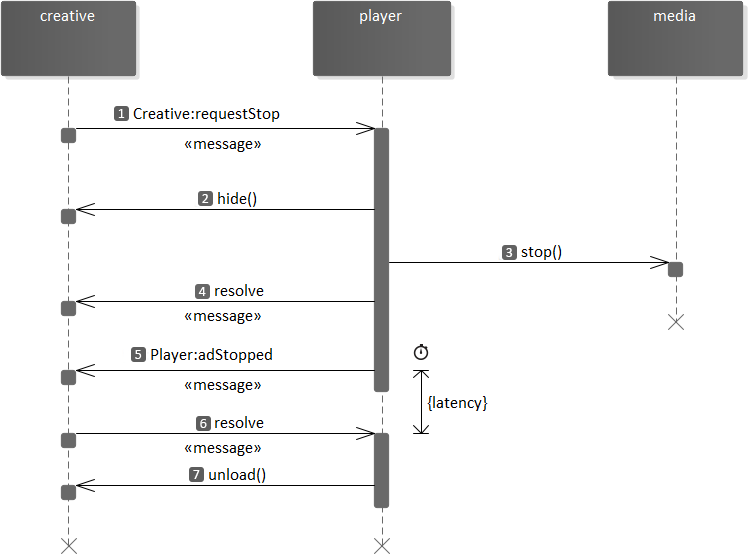
The creative stops the ad by posting a SIMID:Creative:requestStop message.

If feasible, the player hides the iframe, stops media playback that is still in progress, and responds with a § 4.4.14.1 resolve. Subsequently, the player proceeds with the § 4.3.2 SIMID:Player:adStopped.

The SIMID interactive component engages ad stop functionality only if the player states its ability to vary ad duration. See § 4.3.6 SIMID:Player:init, Message.args.variableDurationAllowed details. The interactive component logic must expect that the player will unload SIMID iframe immediately upon posting a resolve response under the SIMID-compliant circumstances.

In the event the interactive component disregards or fails to accommodate player’s ability to resolve requestStop, the iframe remains visible and the player continues sending SIMID:Media and SIMID:Player messages. The creative should maintain communication with the player. See § 4.4.14.2 reject.

Creative:requestStop sequence.
Creative:requestStop Sequence
6.9Ad Duration Changed Workflow
6.9.1Ad Extends Beyond Media Completion

This scenario is only possible when the variableDurationAllowed flag is set to true. Media duration must only be extended in response to user interaction.

  1. User interacts at any point during playback of the media, triggering extended ad portion.
  2. The Creative dispatches § 4.4.6 SIMID:Creative:requestChangeAdDuration message with the new duration.
  3. The ad enters its extended phase.
  4. The creative dispatches § 4.4.14 SIMID:Creative:requestStop when extended phase is finished.
6.9.2Ad Duration Changed Workflow - Known Time
requestChangeAdDuration known duration change handling.
Known Ad Duration Change Sequence
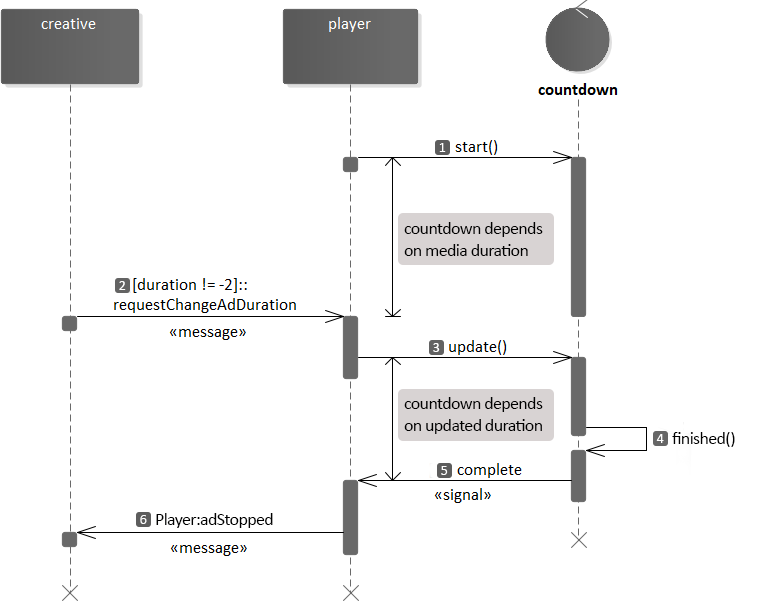
6.9.3Ad Duration Changed Workflow - Unknown Time
requestChangeAdDuration unknown duration change handling.
Unknown Ad Duration Change Sequence
6.10User Experience

Both ad creatives and media players should ensure that consumers are presented with a good ad experience.

This specification does not define the user experience for a close control (close button) or other generic media interaction behavior by the ad creative or the media player. The publisher media player is in full control over its user experience and can present its controls (or hide them) as needed. The publisher media player may dismiss the ad creative at any point in time. Some implementations may have a publisher provided close control, as well as various other controls, and others may not.

The ad creative can also request to be dismissed at any point in time. An ad creative may opt to show its own controls, including a close control.

Official message examples

Examples are reproduced from the official code blocks. Most are JS object literals with unquoted keys — paste them straight into the decoder to verify.

8.1.1Data StructureJS literal

{
sessionId: "173378a4-b2e1-11e9-a2a3-2a2ae2dbcce4",
messageId: 10,
timestamp: 1564501643047,
type: "SIMID:Player:adStopped",
args: {
code: 0
}
}

8.2.1resolve MessagesJS literal

{
sessionId: "173378a4-b2e1-11e9-a2a3-2a2ae2dbcce4",
messageId: 10,
timestamp: 1564501643047,
type: "resolve",
args: {
messageId: 5,
value: {
id: 45
}
}
}

8.2.2reject MessagesJS literal

{
sessionId: "173378a4-b2e1-11e9-a2a3-2a2ae2dbcce4",
messageId: 10,
timestamp: 1564501643047,
type: "resolve",
args: {
messageId: 5,
value: {
errorCode: 902,
message: "The feature is not available."
}
}
}

8.4.1Establishing a New SessionJS literal

{
sessionId: "173378a4-b2e1-11e9-a2a3-2a2ae2dbcce4",
messageId: 0,
timestamp: 1564501643047,
type: "createSession",
args: { }
}

Open in the message decoder